On this page
Every AI writing tool will produce a perfectly competent first draft. The problem? "Competent" means it sounds like everyone else — same sentence patterns, same hedging phrases, same forgettable tone. Training AI on your brand voice is what changes that equation entirely.
This guide walks you through exactly what brand voice training involves, what a proper voice profile contains, and how to put it into practice — so every AI draft reflects your style, not the average of the internet.
The generic voice problem
Ask any AI writing tool to draft a blog post and you'll get something that reads confidently and covers the topic just fine. Ask a different tool to write the same post, and you'll get something almost indistinguishable from the first. That's not a bug — it's what happens when models are trained to produce broadly acceptable output with no specific style to anchor to.
The result is content that passes a quick read but leaves no impression. Your readers can't tell which brand published it. And over time, every post on your site starts to feel like it came from a different author — because, in a way, it did. None of them actually came from you.
Why does that matter? Two reasons. First, brand consistency is a trust signal. Readers who encounter your voice repeatedly — across blog posts, emails, and social copy — build familiarity and credibility associations that convert into subscribers and customers. Second, a consistent voice is an indirect SEO signal. Coherent entity signals across your site help search engines understand who's publishing and whether they're genuinely authoritative on the topic.
What "brand voice" actually means for AI
Most brand voice guides boil down to three adjectives and a mood board. "We're conversational, bold, and human." That's a useful creative exercise — but it's not a technical specification. An AI model can't generate in a consistent style from a list of adjectives. It needs more to work with.
A voice profile that actually changes AI output needs to be specific and operational. It needs to describe the patterns that appear in your writing at a level the model can act on — the sentence structures you default to, the vocabulary you reach for first, the rhetorical moves you use to open and close sections, the punctuation habits that give your writing its rhythm.
Think of it this way: "write in a confident but approachable tone" is a creative brief. A proper voice profile is a style guide. One describes intent. The other describes behaviour. Only one of them tells the AI what to actually do.
Building a voice profile from your writing samples
The most reliable way to build a brand voice profile is to start with real writing — your existing blog posts, email newsletters, or published articles — and analyse them for the patterns that repeat. Large publications have done this manually for decades: their editorial style guides exist precisely because consistent voice doesn't happen by accident.
ImpressWriter's Brand Voices feature automates that entire process. You upload a set of writing samples and the system analyses them to extract tone rules, vocabulary preferences, structural patterns, rhetorical devices, and signature phrases — the specific, observable behaviours that make your writing sound distinctly like you.
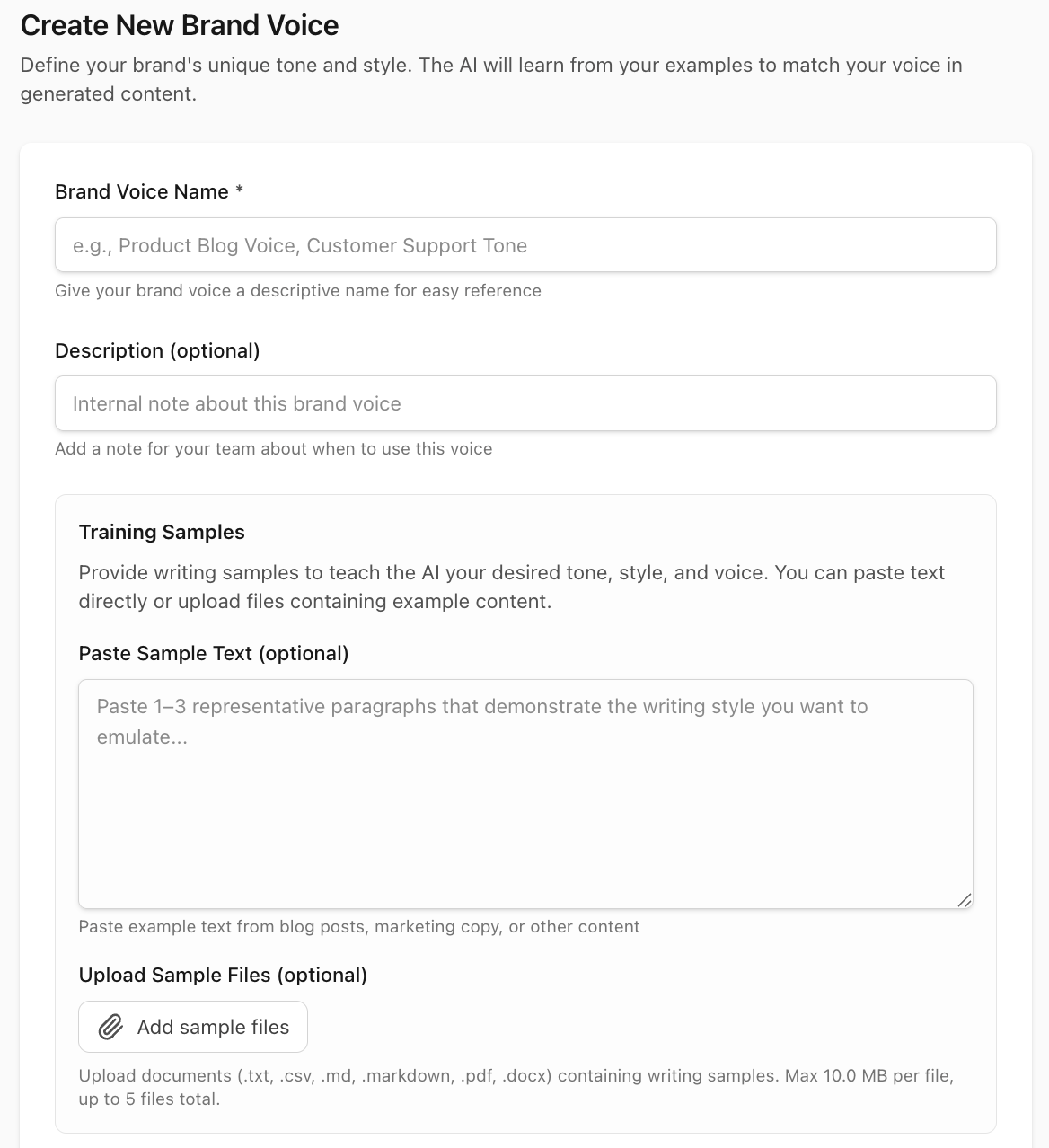
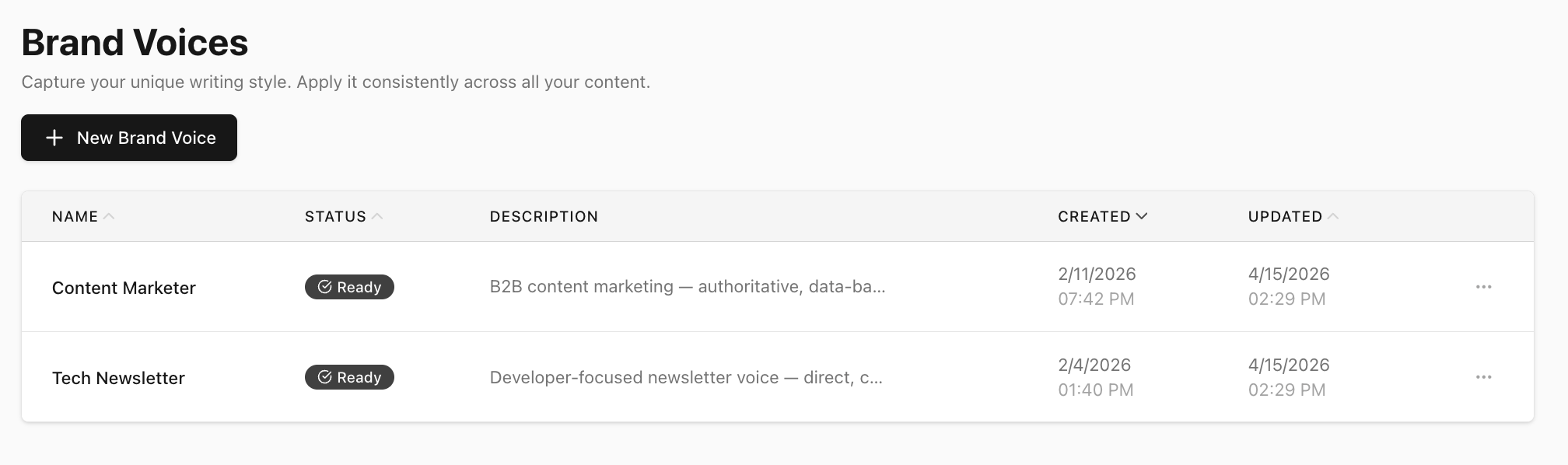
Each profile lives in your library as a named, reusable asset — not a one-time prompt you have to rewrite every session. Once a voice is trained, you can select it whenever you start a new piece. Content teams can maintain multiple profiles: one for long-form blog posts, another for email newsletters, a third for social copy. Each one captures the specific patterns of that format, drawn from your own prior work.
What a voice profile actually contains
A good brand voice profile goes far beyond "tone adjectives." Here's what ImpressWriter actually extracts from your writing samples:
Tone rules
Short, actionable rules in "X, not Y" format — derived from observable patterns in your samples, not invented. For example: "Confident, not arrogant — let evidence do the persuading" or "Direct, not blunt — skip pleasantries, respect the reader's time." These are rules a writer (or a model) can actually act on, not vibes.
Point of view and phrasing patterns
Whether you write in first person ("I've been thinking about this..."), second person ("Here's what you need to know"), or third person. The AI verifies this against verbatim examples pulled directly from your samples — so it sees exactly how your POV is expressed, not just what it is in the abstract.
Diction and vocabulary register
Plain, professional, or technical vocabulary — plus specific word-choice rules derived from your actual text. "Use 'start' not 'initiate'" is far more useful than "write simply." Term preferences and domain-specific terminology are extracted verbatim from your samples.
Mechanics
Whether you use subheadings, how you handle bullet lists, whether you use contractions, how you punctuate. These are observable, testable facts about how your text is formatted — not opinions about how it should be.
Signature phrases and structural patterns
The openers, closers, and rhetorical moves that repeat throughout your writing. "Here's what the data shows:" or "The real question isn't X — it's Y." These are the phrases a reader would recognise as yours even without seeing your byline.
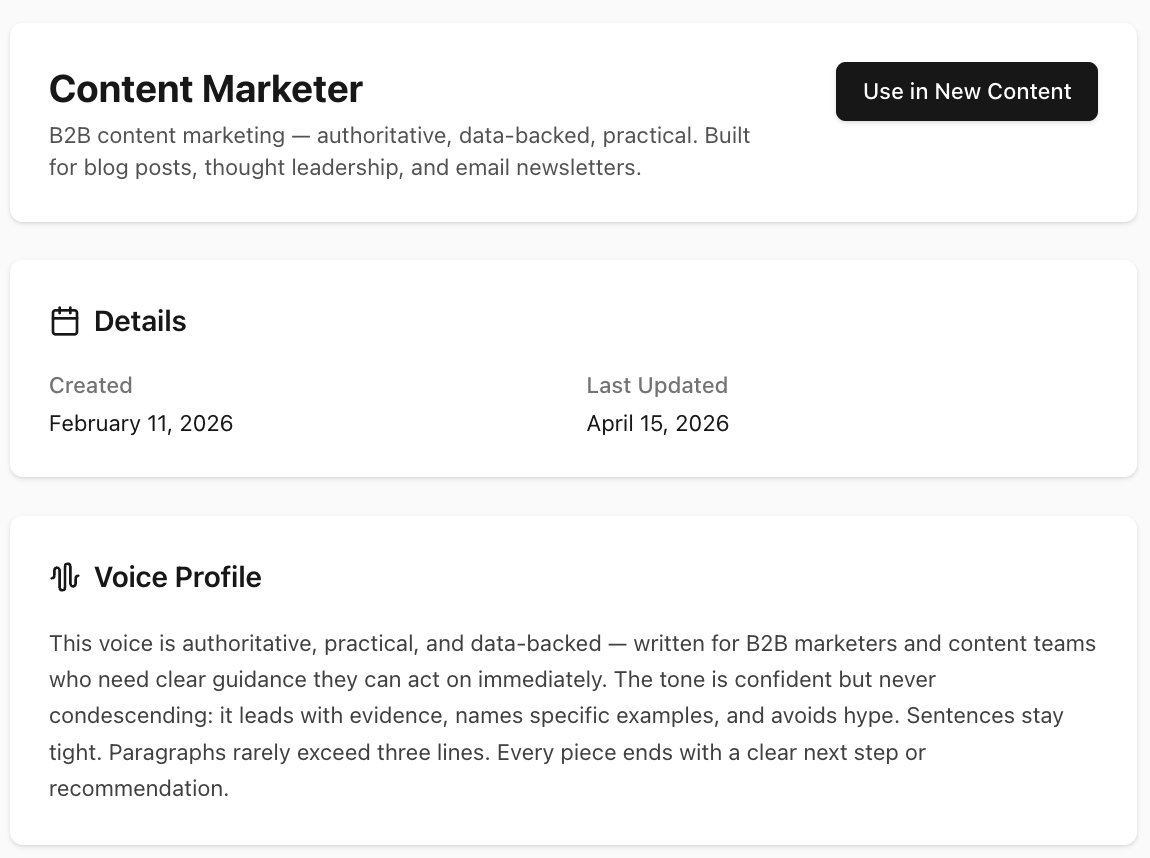
The profile also generates a human-readable writing guide — a formatted document any writer on your team can reference directly. That means your brand voice works beyond AI generation too: it brings contractors, agency partners, and new hires up to speed without lengthy onboarding sessions or back-and-forth revision cycles.
Applying your voice when creating content
Having a brand voice profile is only useful if you actually use it — consistently. The most common failure mode isn't building a bad profile. It's building a good one and then forgetting to apply it because the tool doesn't surface it at the right moment.
In ImpressWriter, brand voice selection is built directly into the content creation flow. Before you start drafting, you choose which profile to apply — and that profile shapes every section of the piece from start to finish. It's not injected as a single system-prompt prefix and then forgotten. It's woven into the generation instructions at each stage of the structured workflow.
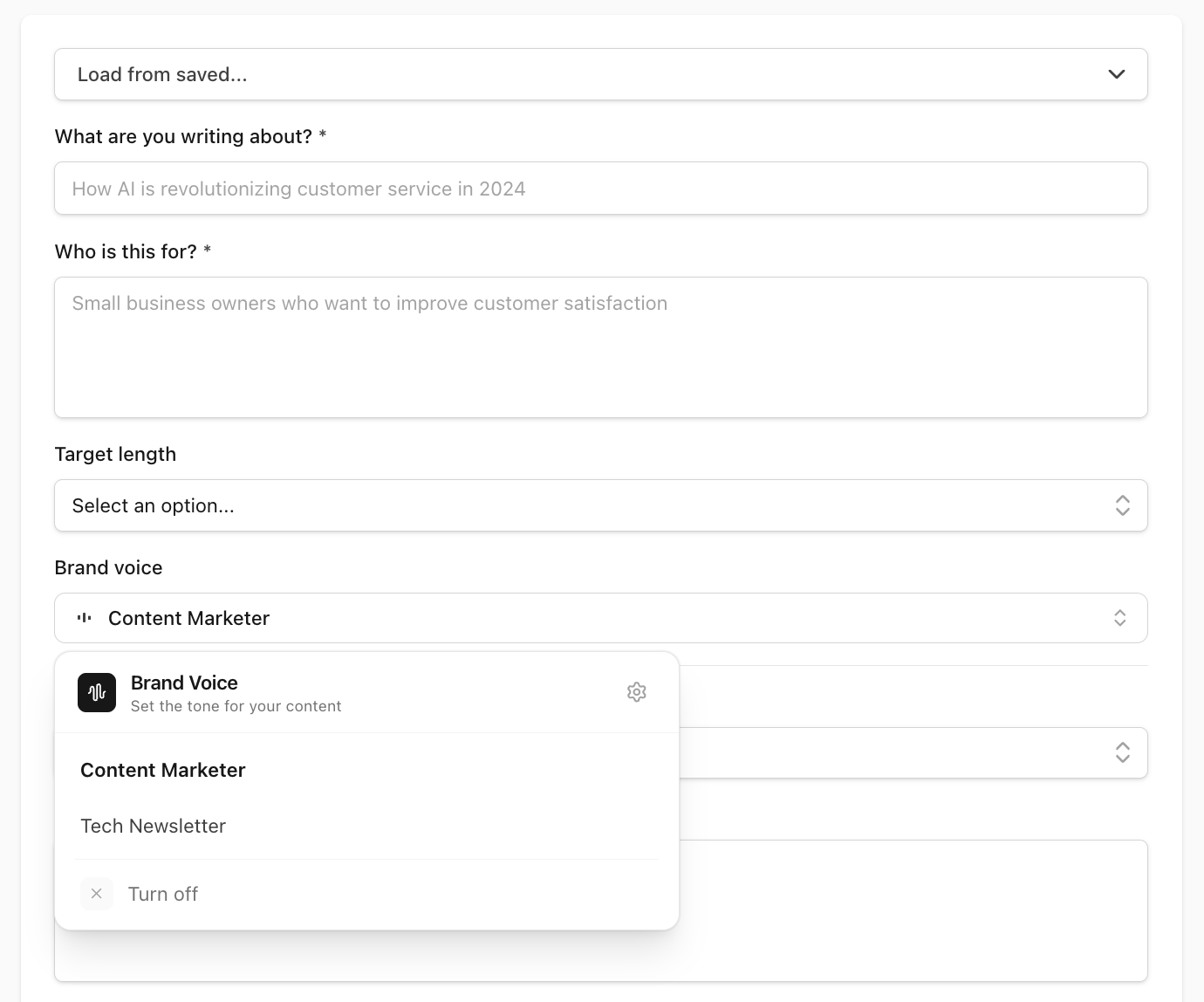
That distinction matters more than it might seem. A voice profile applied once as a prompt prefix influences the model broadly, but it rarely survives a multi-section draft intact — the model drifts back toward its default behaviour as the context grows. A structured workflow that re-applies the voice at each generation step maintains consistency through a full 2,000-word article in a way that a single prompt simply can't.
Build your brand voice profile in ImpressWriter
Upload your existing writing samples. ImpressWriter analyses them and builds a reusable profile that shapes every draft you create — so your content always sounds like you.
The practical workflow
Here's the sequence that works:
Step 1 — Collect 3–5 strong writing samples
Pick pieces that represent your best work in the specific format you want to replicate. Building a blog voice? Use your best blog posts — not email copy or social posts, which follow different conventions. The AI learns from patterns that appear consistently across samples, so quality and consistency matter far more than quantity.
Step 2 — Build the profile and review it
Once the profile is generated, read through the tone rules, diction cues, and signature phrases. If something looks off — a phrase you'd never use, a structural pattern that doesn't reflect your writing — cut it. The profile is fully editable because no automated analysis gets everything right. The review step is also your chance to add patterns the model missed: specific terms you always use, preferred CTAs, structural habits that didn't come through in the samples.
Step 3 — Apply the profile to every new piece
Select your voice profile at the start of each content creation session. Don't skip this step or treat it as optional — the entire value of the system lives in consistent application. A voice profile used on 80% of your posts will still produce noticeable inconsistency in the 20% where you skipped it.
Step 4 — Update the profile as your voice evolves
Brand voice isn't static. As your writing matures — as you develop new patterns, drop phrases that no longer fit, or shift tone for a new audience — your profile should reflect where your writing is now, not where it was 18 months ago. ImpressWriter stores your profiles as editable assets so they can grow alongside you.
Conclusion
The difference between AI content that sounds generic and AI content that sounds like you isn't about which model you use or how long your prompt is. It's about whether you gave the model something specific and structured to work from — a voice profile built from real writing samples, not a handful of adjectives.
Brand voice training is a one-time setup with compounding returns. Build the profile once, apply it consistently, and the gap between your AI-assisted content and everyone else's gets wider with every piece you publish. The teams getting this right aren't creating more content. They're creating more recognisable content — and that's what actually builds an audience.
Most teams get this backwards: they generate first and try to edit the voice in afterwards. That's slower, less consistent, and still feels slightly off. The right order is simple — establish the voice, then generate.